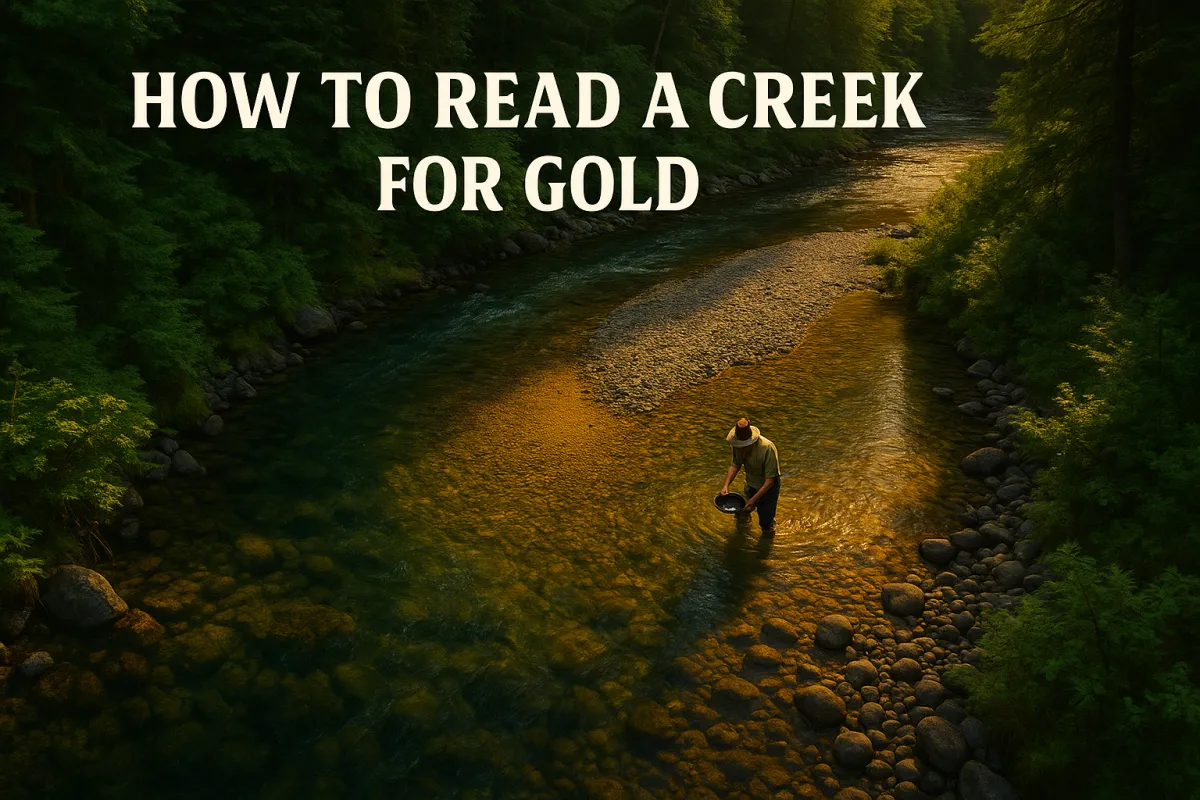
How to Read a Creek for Gold — Where It Actually Settles and Why
Gold Doesn't Move Randomly — It Follows Physics
One of the biggest shifts in a prospector's skill level happens the moment they stop thinking about gold as something they search for and start thinking about it as something they predict. Gold follows rules. Precise, repeatable, physics-based rules. Once you understand those rules, you stop hunting randomly and start reading the water like a map.
Here's everything you need to know to read any creek or river and identify exactly where gold has concentrated — before you dig a single scoop.
Why Gold Settles Where It Does
Gold's specific gravity is approximately 19.3 — meaning it's about 19 times denser than water and roughly 7 times denser than the quartz gravel that makes up most creek material. When water carries material in suspension, it can only move particles proportional to its velocity and turbulence. The moment water slows down or loses energy, the heaviest material drops first.
Gold doesn't flow with the current for long. It hops and rolls along the bottom, always working downward, always seeking low-velocity zones where the energy required to keep it moving no longer exists. Understanding this is the entire science of placer gold in one concept.
The prospector's core principle: Find the places where water velocity drops dramatically — that's where gold drops too.
The 6 Places Gold Always Concentrates
1. Inside Bends — Your Most Reliable Target
Look at any river or creek from above. It curves constantly. On the outside of every curve, centrifugal force pushes water faster and harder against the bank, cutting it deeper. On the inside of that same curve, water slows significantly.
The result: heavy material — including gold — drops out of suspension on the inside of every bend. This creates the natural gravel bars you see on inside curves, and those gravel bars are often loaded with concentrated gold in the lower layers.
How to work it: Dig down into the gravel bar, not just the surface. Gold concentrates at the base of the bar, often right on or near bedrock. Surface material has been reworked by recent flows and is usually depleted. Dig 4-8 inches down before you start panning.
2. Behind Large Boulders — The Downstream Trap
Any boulder large enough to significantly break the current creates something called an eddy — a low-velocity or even reverse-flow zone immediately downstream. Gold carried along the bottom hits this zone and drops.
The bigger the boulder, the bigger the eddy zone, the more material that's been trapped. Some of the richest single spots in any productive creek are the downstream side of the largest boulders in the channel.
How to work it: Dig in the gravel immediately behind the boulder — not beside it, behind it. The eddy extends 2-5 boulder-diameters downstream depending on flow rate. Work the full eddy zone systematically.
3. Base of Waterfalls and Rapids — Turbulence Traps
At the base of any waterfall or significant rapid, enormous turbulence drops everything heavy into the plunge pool below. The physics are simple: all that kinetic energy dissipates when the water hits the flat pool, and everything the current was carrying gets dumped.
The flat pool immediately below any waterfall — especially along the leading edge where fast water meets the still pool — is one of the highest-value prospecting targets that exists. Bedrock potholes in these areas trap extraordinary concentrations of gold over time.
How to work it: Focus on the first 10-20 feet of the pool below the falls. Work any exposed bedrock crevices in this zone — they're natural gold collectors that have been filling for potentially thousands of years. A crevicing tool and patience here can outperform hours of general panning.
4. Exposed Bedrock and Its Cracks — The Ultimate Trap
Gold sinks through sand, sinks through gravel, and then hits bedrock — something it physically cannot pass through. It settles into every crack, pothole, and irregularity in the bedrock surface and stays there, sometimes for thousands of years, accumulating with every high-water event.
Exposed bedrock sections in any gold-bearing creek are premium real estate. The rougher the bedrock surface — the more cracks, potholes, and irregular features — the better the trap.
How to work it: Get down and work every visible crack with a crevicing tool. Use a squeeze bottle of water to flush material out of narrow crevices into your pan or bucket. Don't skip small cracks — a crack 1/4 inch wide can hold surprising quantities of concentrated gold. This is painstaking work that produces some of the best results per hour of effort of anything in prospecting.
5. Where Two Streams Meet — Confluence Zones
Every point where a tributary joins a main creek or river creates hydraulic complexity — two currents collide, velocity changes occur across a wide area, and heavy material drops across the entire confluence zone. The area 10-30 feet downstream of any stream confluence is worth investigating in a gold-bearing drainage.
Larger tributaries create larger effects. The joining of two productive drainages concentrates gold from both systems into one zone — a natural aggregation point.
How to work it: Test pan the downstream zone of the confluence at several points. Pay attention to which side of the channel (the main creek vs. the tributary side) is producing more black sand — that tells you which system is contributing more material and where to focus.
6. Ancient Bench Deposits — The Overlooked Treasure
Rivers cut downward through time. Ancient river channels that once carried gold-laden gravel now sit high above the current water level — sometimes 20, 50, or 200 feet above the creek you're standing in. These elevated gravel deposits are called bench deposits, and they represent ancient placer gold that was never disturbed by subsequent floods.
In many historically productive areas, bench deposits contain more gold than anything in the active stream — because they've been accumulating since before human activity and haven't been prospected the way the accessible creek bed has.
How to find them: Look for rounded river gravel (not angular weathered rock) on hillsides and terraces above the current creek level. Rounded gravel means water transport — if you see it elevated above the stream, you're looking at an ancient channel. Test pan material from these deposits.
The Black Sand Signal
Black sand — primarily magnetite — is your field indicator for gold-trap conditions. Both gold and black sand concentrate by the same hydraulic processes in the same locations. A pan full of heavy black sand tells you the physics at that location are working correctly. No black sand at all means you're in the wrong spot — the water is either too fast to deposit heavy material or the bedrock geometry isn't creating a trap.
When test panning a new area: check for black sand before you check for gold. Heavy black sand concentration tells you you've found the right spot. Work that spot thoroughly before moving.
Seasonal Changes — How Water Level Affects Gold Location
Gold deposits shift with changing water levels, and knowing this makes you a more productive prospector year-round.
Spring / snowmelt: High water moves gravel and redistributes gold. Fresh deposits form in new locations. The inside bends and eddy zones that are productive in late summer may look completely different after spring floods rework the channel.
Late summer / low water: This is prime prospecting season in most regions. Water is low, bedrock is exposed, gravel bars are accessible, and visibility into the stream is maximized. Low water means you can work spots that are underwater or dangerous to approach the rest of the year.
After heavy rain: Storm runoff concentrates and moves material, creating fresh deposits in trap zones. Prospecting 24-48 hours after a significant rain event — once water clears — often produces excellent results in areas you've already prospected, because new material has been deposited.
Putting It All Together
Before you dig anywhere, walk the accessible section of creek first. Look for:
- Inside bends with gravel bars
- Large boulders with downstream gravel accumulations
- Any waterfall or significant rapid
- Exposed bedrock sections
- Stream confluences
- Elevated gravel terraces above the current creek level
Rank your top 3 spots and test pan each with 2-3 loads before committing. The spot producing the most black sand in the early test pans is your spot for the day. Commit to it and work it thoroughly rather than jumping around.
Prospectors who read the water before they dig consistently outperform those who just start digging at the first spot that looks accessible. The 10 minutes you spend walking and reading the creek will produce more gold than 2 hours of random digging in the wrong spots.
Ready to Find Your First Gold?
Understanding creek hydraulics is the foundation. Knowing which states have the most accessible public-land gold — and exactly where to go in each one — is the second piece.
Our Complete Gold Rush Kit covers everything: panning technique in depth, gear for every budget, our state-by-state location guide, legal framework, and printable field cheat sheets. Everything from zero to your first find, $67, instant download.
Or start with our Gold Prospecting by State guide if you're ready to find your specific location now — $37, all 50 states covered.
Now go read some water. ⛏️

